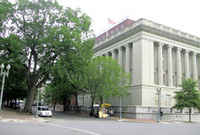
U.S. Treasury Annex, Carol Highsmith
United States Treasury Annex
- Location:
- Madison Place and Pennsylvania Avenue, Washington, D.C., Washington, D.C.
- Design & Construction:
- 1917-1918 [1917-1922 Irish-1999]
- Architect:
- Cass Gilbert
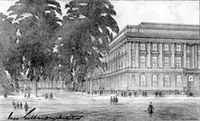
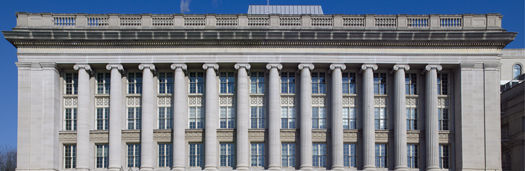
This building was originally planned to extend the entire length of Madison Place. Following the scheme suggested by the McMillan Commission and stimulated by Robert Mills's east façade of the Treasury Building, Gilbert planned to frame the entire square with an almost continuous colonnade. Built of Indiana limestone, the Treasury Annex's two identical façades consist of rusticated basements set behind retaining walls and a giant Ionic colonnade framing three stories lit by floor-to-ceiling windows. The deep entablature masks a skylit story, and a recessed attic is partially obscured by the balustrade. This arrangement was a typical Beaux-Arts solution for minor urban office buildings that were meant to provide a contextual visual support for their more important and monumental neighbors. Instead of copying the style of the Ionic of the Erechtheum as it was used in the Treasury Building, Gilbert chose that of the Temple on the Ilissus in Athens, thus maintaining simple Greek lines but varying the details.
See Also
-
Pamela Scott and Antoinette Lee. Buildings of the United States: Buildings of the District of Columbia (New York: Oxford University Press, 1993).